AI Insight
The $3 Trillion AI Sell-Off: Will the Data Center Boom Pay Off?
Wall Street lost its nerve on AI this week. Here's who lost the most, what the AI labs are really building, and why builders win either way.
Will the AI data center boom pay off? For some investors, probably not.
For the people building on top of it, almost certainly yes.
This week, Wall Street lost its nerve. About $3 trillion left US stocks in two days, and Nvidia alone lost more than $440 billion on Thursday.
Here's who lost the most and why, what the AI labs are really building, and how I think this ends.
This isn't investment advice. It's a builder's view of where the money goes.
What happened on November 4 and 5?
Two things hit at once.
The trigger was political. The midterm results raised fears of tighter rules on data center construction. One governor-elect had campaigned on a temporary data center moratorium. (CNN)
The fuel was a doubt that had been building for months: will all this spending ever earn its money back?
On Thursday, November 5, the Nasdaq fell 5.5%, its worst day since April 2025. The S&P 500 fell 4.4%. Across two days, the Wall Street Journal put the damage at about $3 trillion of US stock market value. (Longbridge, citing the WSJ)
Who lost the most, and why?
Here's the one-day damage for the biggest names on Thursday.
One day, November 5: market value lost
Approximate, from reported closing data. The two chipmakers fell furthest.
Across November 4–5, about $3 trillion left US stocks (WSJ). Red: companies that make the chips. Grey: companies that buy them.
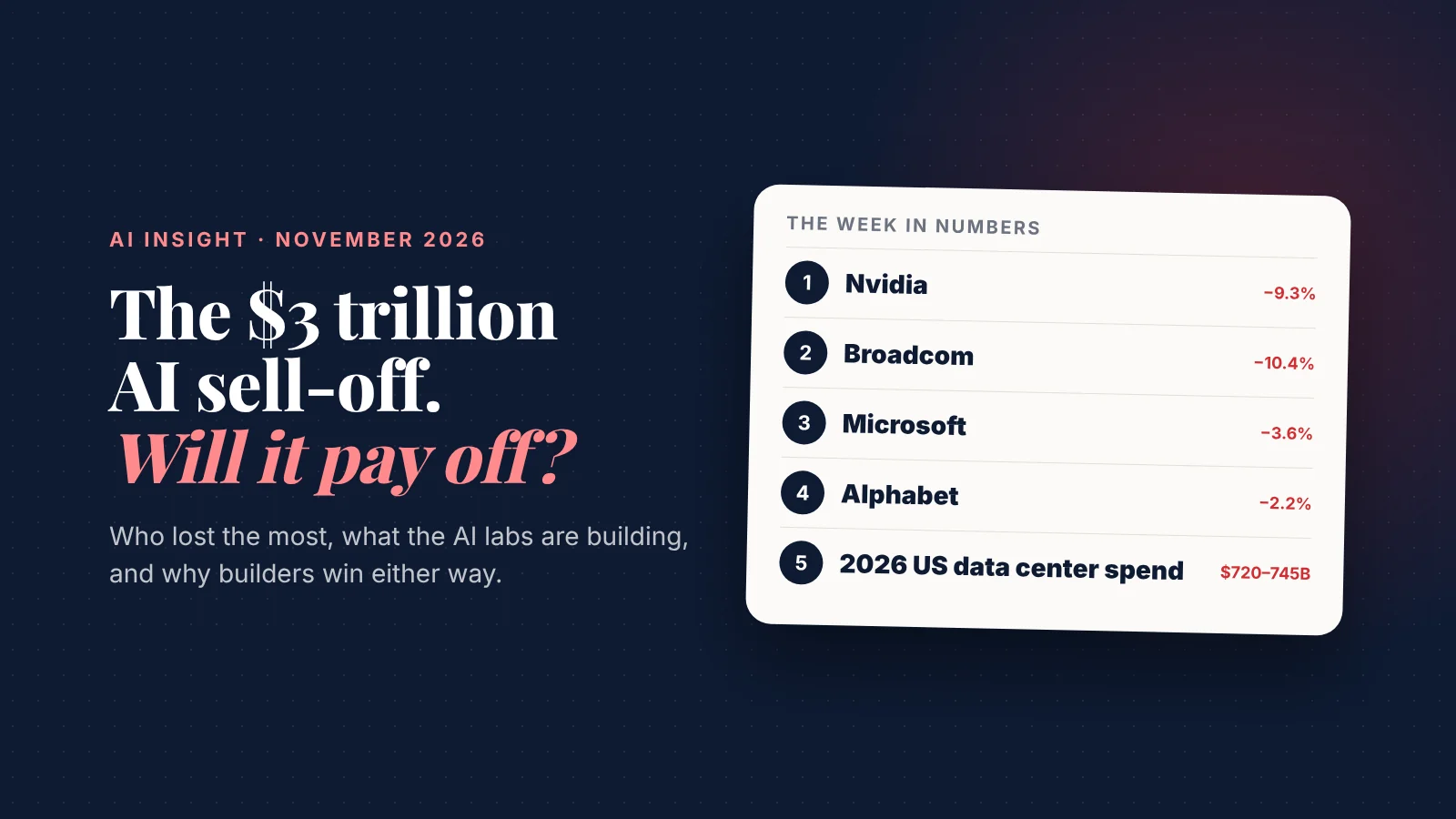
Nvidia: down 9.3%, about $440–450 billion. Its worst day since April 2025. Nvidia sells the chips every data center needs, so it's the purest bet on the build-out. On top of the political fear, reports pointed to worries about vendor financing and chip stockpiling in Hong Kong. It's now about 24% below its October 6 peak, and it reports earnings on November 17. (CNBC via FinanceFeeds, BigGo)
Broadcom: down 10.4%, about $162 billion. Broadcom designs custom AI chips and networking for the biggest tech companies. Same bet, same fall.
Microsoft: down 3.6%, about $148 billion. Microsoft is one of the biggest spenders. Here the worry runs the other way: investors fear spending is rising faster than free cash flow.
Alphabet: down only 2.2%, about $68 billion. Reports named no Alphabet-specific cause.
Are they related? Yes. It's one question priced four ways: will the data center build-out continue, and will it pay?
The companies that make the chips fell about twice as far as the companies that buy them.
That's the market saying the build-out could slow before the buyers' businesses do.
The real spenders: Anthropic, OpenAI and xAI
The public giants write the biggest checks. But the three AI labs are the reason the checks get written.
Anthropic filed to go public in October. Its filing shows revenue of $16.3 billion in the first half of 2026, up from $1.2 billion a year earlier, and an annualized run rate of about $65 billion by July. After this week, investors told the WSJ its IPO valuation may need to fall from about $1.5 trillion toward $1 trillion, or the listing may be delayed. (CNBC, Benzinga, Fortune)
It mostly rents its compute: reportedly about $1.25 billion a month to SpaceX for xAI's Colossus data center, plus tens of billions in deals with other providers.
OpenAI is private, valued at about $1.25 trillion. Its run rate passed $40 billion in August. It projects revenue of roughly $280–350 billion by 2030 (reports differ), and about $278 billion of negative cash flow from 2026 to 2030 on the way there. Its current funding round is coming in under target, and its IPO has moved to next year. (Tom's Hardware, CNBC)
xAI is now part of SpaceX, which is public. It built Colossus in Memphis, and it now rents that compute to other labs.
So here's the twist. The labs spending the most aren't the ones that lost the most this week. Two of them aren't even listed yet. Their test comes later, at the IPO window.
How much is being spent, and where?
2026 data center and AI infrastructure spending
Company guidance (US) and analyst estimates (China). Not all of it is AI.
US big four together: $720–745B. China's big four (Alibaba, Tencent, Baidu, ByteDance) are smaller but growing faster.
The four US giants alone plan $720–745 billion of capital spending in 2026: Amazon about $220 billion, Alphabet $195–205 billion, Microsoft about $170–175 billion and Meta $130–145 billion. Not all of it is AI, but most of the growth is. (MLQ)
China's big four (Alibaba, Tencent, Baidu and ByteDance) are estimated at $102–139 billion. That's much smaller, but growing faster. (Al Jazeera, Rhodium Group)
Will it pay off?
Here's the honest gap.
The book
Build your own AI product. No coding skills required.
- 29 chapters, five levels, step by step
- Three complete builds, start to finish
- Templates, checklists and a prompt kit
- Chapter 1 is free to read, in full

Goldman Sachs estimates the biggest US spenders need about $300 billion a year in AI revenue just to break even on 2026's spending. Gartner's tougher test, a 12% return through 2030, leaves a shortfall of about $4.9 trillion. (TechTimes, Fortune)
And there's a hidden risk: chips are written off over five or six years. If they're outdated sooner, today's profits are flattering.
But revenue is moving fast. Anthropic went from about $9 billion to $65 billion in seven months.
So I see three ways this goes.
Three ways the AI build-out can go
Overbuild
Spending outruns revenue. Some data centers sit half-used, investors take losses, prices for AI fall fast. Builders still benefit.
Steady payback
Revenue keeps compounding and closes the gap over several years. Uneven, with pockets of overbuild. My base case.
Breakout
AI agents and new apps pull demand ahead of supply. Capacity sells out and the spending looks cheap in hindsight.
My bet is the middle, with pockets of the first: some data centers will be built too early, some investors will lose, and the capacity will still get used.
Will demand catch up with all this capacity?
This is the question under all the others. So I made a simple projection to 2030, starting from three measured growth rates.
By 2030: AI usage vs AI capacity vs data center power
My projection, growth from 2025 to 2030 (2025 = 1×). Log scale: each step is ten times the last.
My projection, not a forecast. How I made it is explained right below.
How I made this projection
I took three things we can measure today and asked: if each keeps growing the way it's growing now, but a little slower every year, where is it in 2030?
1. Data center power: about 2 times.
- What it measures: the electricity all data centers use.
- Where the number comes from: the International Energy Agency's main forecast, about 415 TWh in 2024 rising to about 945 TWh in 2030. (IEA)
- Why it grows slowest: new power plants and grid connections take years to build.
2. AI computing capacity: about 30 to 100 times.
- What it measures: how much AI work all the chips in the world can do.
- Where the number comes from: Epoch AI finds new AI computing capacity doubling about every nine months. (Epoch AI)
- My assumption: it grows 2 to 2.5 times a year, then slows as power runs short.
- Why it beats power: each new generation of chips does far more work with the same electricity.
3. AI usage: about 70 to 900 times, most likely around 300 times.
- What it measures: how much people and AI agents actually use AI, counted in tokens (small pieces of text the AI reads or writes).
- Where the number comes from: Google's monthly tokens grew about 7 times in a year, from about 480 trillion to over 3.2 quadrillion. Microsoft reported about 5 times. (I/O Fund)
- My assumption: growth slows every year, to 5×, then 4×, 3×, 2.5× and 2×. Multiply those and you get about 300 times. Slower and faster versions give the 70 and 900.
It's an extrapolation, not a forecast. Companies count tokens differently, and AI agents use far more tokens than people do, which could push usage even higher.
But the shape is the point. Usage is growing faster than capacity, and capacity faster than power. If that holds even roughly, today's data centers get used. The risk isn't empty buildings. It's that prices per token fall so fast that revenue lags behind usage.
The bottleneck nobody can buy: power
Elon Musk keeps making the same point: the limit on AI isn't chips. It's electricity.
SpaceX builds its own gas turbines and batteries to skip years of waiting for a grid connection. Musk says Google and Anthropic lease SpaceX compute because power is short. (Benzinga)
That's also why people are talking about data centers in space. SpaceX has asked regulators to approve a solar-powered computing constellation, with demonstrations planned for late 2027. Google's Project Suncatcher plans small orbital prototypes by 2027. (CarbonCredits)
Promising, but early. US government auditors call cooling in orbit unproven at scale, and Google's own energy chief has warned it could cost far more than on the ground. (Benzinga)
For this decade, the winners are whoever secures power on Earth.
Where will the growth come from?
Here's where I'm most optimistic.
First, AI is getting better at building AI. The labs already use their own models to write code and run experiments for the next ones. That's the early form of what researchers call recursive self-improvement. It's also why each lab publishes a safety policy with tests a model must pass before it's released. The real question isn't whether this happens. It's whether the guardrails keep pace, and that's worth watching closely.
Second, intelligence is becoming a utility. The price of the same AI output has collapsed: one study puts the fall at roughly 600 times since 2020, while the amount people use keeps exploding. (arXiv)
That's what electricity looked like once.
The railroads and the fiber networks of the early 2000s both lost their first investors money. Then the cheap capacity they left behind powered the next wave of companies.
Third, the value moves to the edges. When intelligence is cheap, the winners are the apps and startups that turn it into something a customer will pay for: a better clinic schedule, a faster legal draft, a website that answers questions at 9 p.m.
The forecasts point the same way. Gartner expects about $1.2 trillion a year of spending on AI software, mostly apps and agents, by 2030. It puts revenue from the AI models themselves, what the labs sell, at about $239 billion. (Software Strategies, summarizing Gartner)
Where the AI money lands by 2030
Gartner projections for 2030, as summarized by Software Strategies.
About five dollars on apps and agents for every dollar on the models underneath. The two forecasts use different scopes, so read it as a direction, not an exact ratio.
And AI-native startups already grow faster than any software wave before them. In Stripe's data on the top AI companies, Cursor passed $100 million in annual revenue in about three years. Lovable got there in months; reports range from 8 to 14 months depending on how it's counted. (Stripe, TechCrunch)
There's a second group I find just as important: ordinary companies using AI to grow. A clinic, a law firm or a plumber doesn't sell AI. They use it to answer customers faster, write their content and win the next job. That's where most of the world's businesses will meet AI, and it's the part no one can count yet.
I built SiteNeuro as a non-developer, with Claude and written specs, together with two engineer partners. It has built 1,000+ websites. That wasn't possible for someone like me three years ago. Every drop in the price of intelligence makes more of those stories possible.
Full disclosure: SiteNeuro is built on AI models, so cheaper AI helps my company. Weigh my view accordingly.
What should a builder do this week?
- Don't wait. If prices for AI fall, your costs fall with them. Building now means you're ready when they do.
- Stay portable. Write your product in specs, not around one model's quirks, so you can switch providers when prices move.
- Build where the value lands. A specific customer problem, not another general-purpose AI tool.
- Watch November 17. Nvidia's earnings will tell us whether the spending plans are holding.
Is AI a bubble?
Parts of it may be. Valuations and some data centers are priced for a future that may arrive later than hoped. The underlying use isn't a bubble: revenue at the leading AI labs grew several times over in 2026.
Will AI data centers pay off?
Not all of them, and not for every investor. Estimates of the revenue gap range from about $300 billion a year to break even (Goldman Sachs) to about $4.9 trillion short of a 12% return through 2030 (Gartner). Capacity built too early usually still gets used, at lower prices.
Why did Nvidia fall more than Microsoft or Alphabet?
Nvidia sells the chips, so it depends most on the build-out continuing. Microsoft and Alphabet buy the chips and also earn money from cloud services and software, so a slowdown hits them less directly.
What did the sell-off have to do with the midterms?
Investors feared new limits on data center construction after the election results, and that fear hit at a time when doubts about AI spending were already growing.
Will AI get cheaper?
The price per unit of AI output has fallen sharply for years and is still falling. Total spending can rise anyway, because people use far more of it.
Should a startup wait until the market settles?
No. Startups don't buy data centers; they rent AI by the use. Falling prices lower your costs. The bigger risk is tying your product to a single model.
 What is SiteNeuro?The AI growth platform for small businesses and entrepreneurs, starting with a website.See the sites it builds and the marketing it runs, in the showcase →Rated Excellent on Trustpilot
Building an AI platform?
I built SiteNeuro as a non-developer, with Claude and written specs: 1,000+ websites built so far.
If you're turning an idea into an AI product, I can help you shape the business case, set up Claude and your specs, and plan a first build that doesn't loop.