Build With AI
How to Build an MVP With AI in 30 Days (Without Writing Code)
Thirty days is enough to put a real product in front of users, if the first week goes on specs, not code.
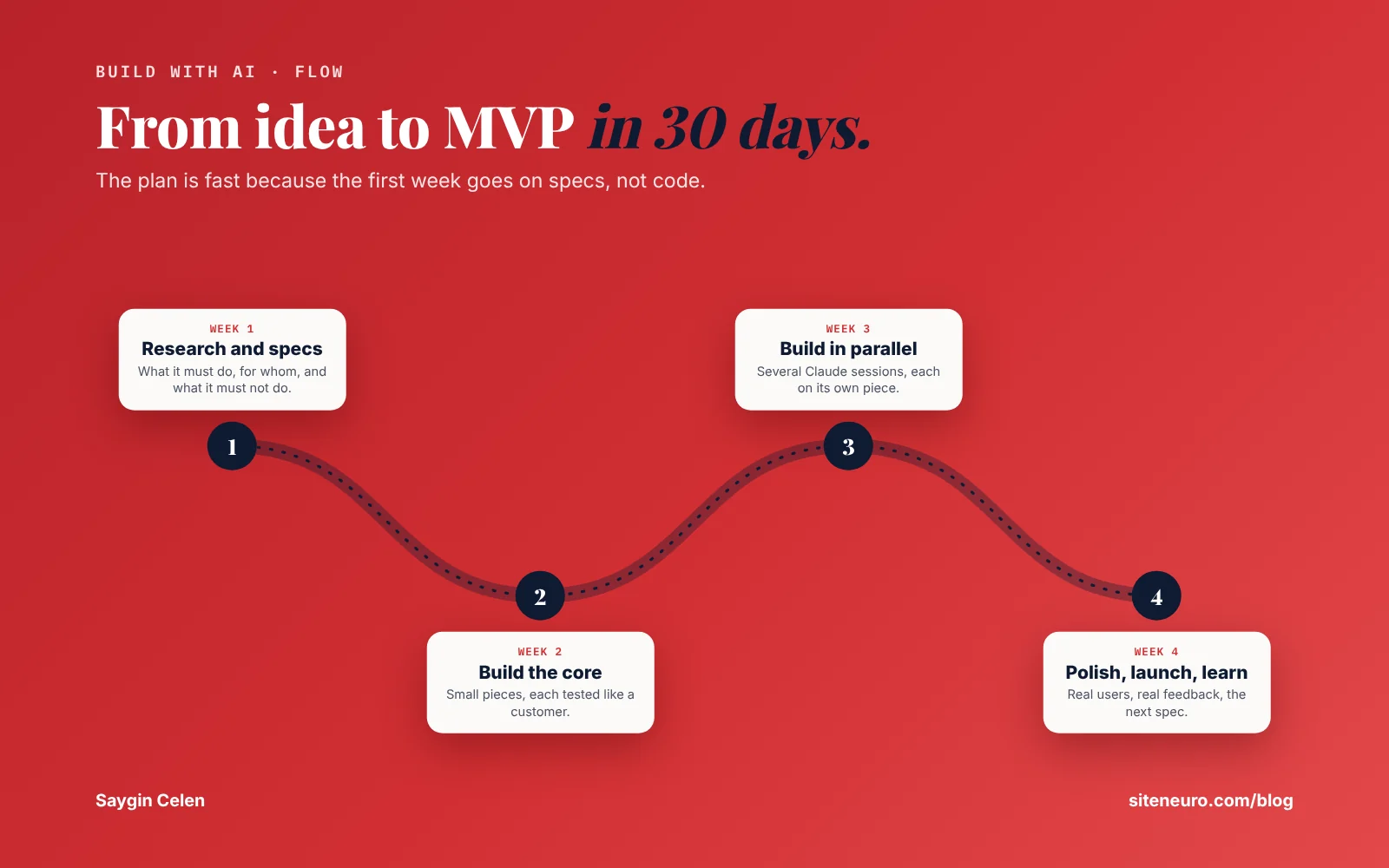
How do you build an MVP with AI in 30 days? Spend week one on research and specs, not code.
Decide what the product must do, for whom, and what it must not do, and cross-check it with several AI models.
Then build in small tested pieces with Claude Code in weeks two and three, running several sessions at once.
Use week four to polish, launch to real users and learn.
The plan is fast because the foundation is solid.
If I started SiteNeuro again today, I'd get to a working product much faster.
Not because I'd type faster.
Because I'd plan better.
I'm the founder of SiteNeuro, and I'm not a developer.
Building it with Claude Code taught me that the biggest time savings don't happen while building.
They happen before.
Here's the 30-day plan I'd follow now, based on what worked, and what cost me time.
First: what an MVP really is
An MVP, a minimum viable product, is the smallest version of your idea that real people can use and that solves one real problem.
Not a demo. Not a slide deck. Not everything you've imagined.
One problem, solved well enough that someone would use it again.
Week 1: Research and specs (no code yet)
This is the week most first-timers skip. It's the week that matters most.
The spec is the foundation. It decides how smart and solid your product will be later, and getting it right saves an enormous amount of time during the build.
Days 1–2: Research the need.
- Who exactly has this problem?
- How do they solve it today?
- What would make them switch?
- What would a professional version of this product need to include?
Use ChatGPT, Claude and other assistants to research, but talk to real potential users too.
Days 3–5: Write the specs with Claude.
- Your constitution: what the product is, who it's for, the rules nothing may break
- The 3–5 core features, each with its own spec
- What you don't want, written as clearly as what you do
Days 6–7: Cross-check the plan.
Take the plan to ChatGPT and other models. Ask what's missing, what's risky, what could be simpler. Bring their answers back to Claude and ask it to merge the best ideas into a final version 1.
A strong spec is the difference between building a product and building a pile of fixes.
How I structure specs: spec-driven development with Claude Code. Why I stopped vibe coding: vibe coding vs spec-driven development.
Week 2: Build the core
Now Claude starts building.
- One feature at a time. Smallest useful piece first.
- Test each step yourself, like a customer, on desktop and phone.
- Give clear instructions. Point Claude at the spec; describe problems with screenshots.
- Every fixed mistake becomes a rule in the spec and Claude's memory.
By the end of week two, the core problem should be solvable end to end, even if it's rough.
Week 3: Build in parallel
This is where you can go much faster than I did at the start.
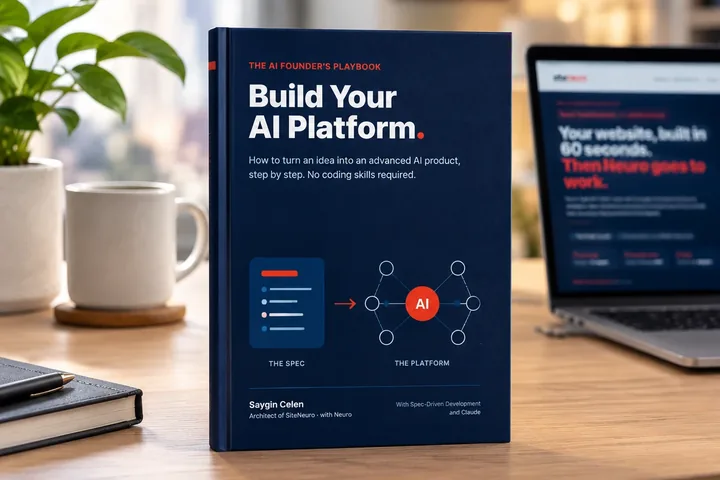
The book
Build your MVP the spec-driven way.
Build Your AI Platform takes non-developers from idea to live product with Claude and Spec-Driven Development. Chapter 1 is free.
- 29 chapters, five levels, step by step
- Three complete builds, start to finish
- Templates, checklists and a prompt kit
- Chapter 1 is free to read, in full
Run several Claude sessions at once, each on a separate, well-specced task. One builds a feature, another fixes a reported bug, another drafts the onboarding text.
It only works because of week one. Clear specs let each session work independently without breaking the others.
Use each session effectively:
- One clear goal per session
- The spec as the starting point
- Test before starting the next task
Week 4: Polish, launch and learn
- Days 22–24: fix the rough edges real users will hit first. Sign-up, the first screen, the main action.
- Days 25–26: a simple landing page that says who it's for and what it does.
- Days 27–28: put it in front of real users. Ten honest users beat a thousand imaginary ones.
- Days 29–30: collect feedback, turn it into new rules and new specs, and plan the next 30 days.
What I'd do differently
Looking back, two things stand out.
1. I'd build the specs better, and plan with Claude more.
The foundation shapes everything after it. More planning and more cross-checking with other models up front would have saved much more time later.
2. I'd use sessions more effectively.
Clearer instructions, several sessions working at once, and faster error fixing. All much easier now than when I started.
But I wouldn't skip the trial and error entirely. Building is a trial-and-error process, and I learned an enormous amount from it.
What first-timers underestimate
It still takes real learning, effort and time.
AI removes the need to write code. It doesn't remove the need to think. Planning takes due diligence: research into what's needed, what's not wanted, and whether people will actually use the product.
But here's the other side of that:
It's a forever skill.
Once you learn to build with AI and specs, you can build any product you want, without being limited by technical skills or by finding co-founders. That's what changed for me, and I wrote about it in non-technical founder, no co-founder.
What first-timers underestimate, and what they get
It still takes
- Real learning, effort and time
- Thinking: AI removes the code, not the thinking
- Research: what's needed, what's not wanted, and whether people will use it
What you get
- A forever skill
- You can build any product you want
- Without being limited by technical skills or by finding co-founders
The 30-day plan on one page
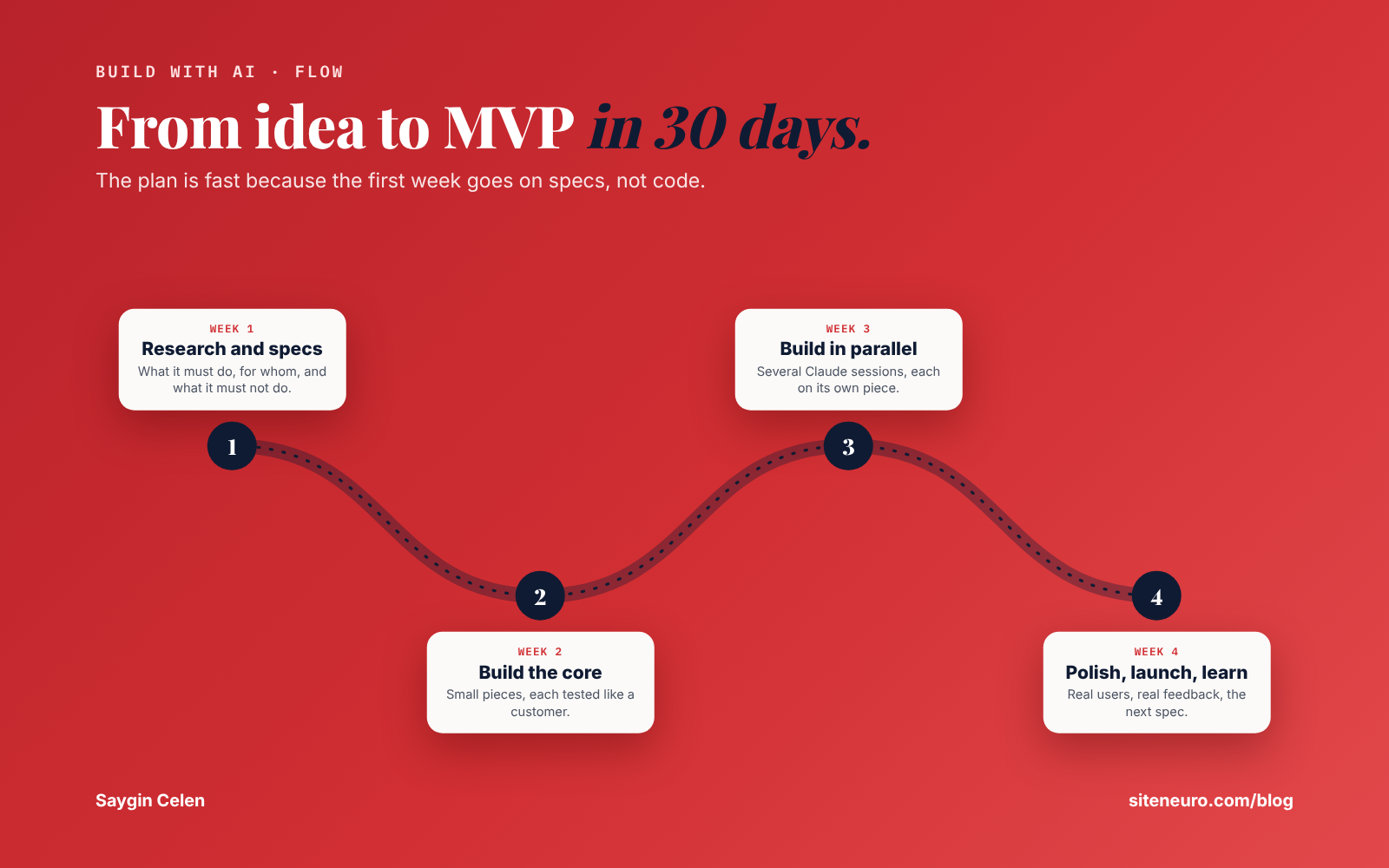
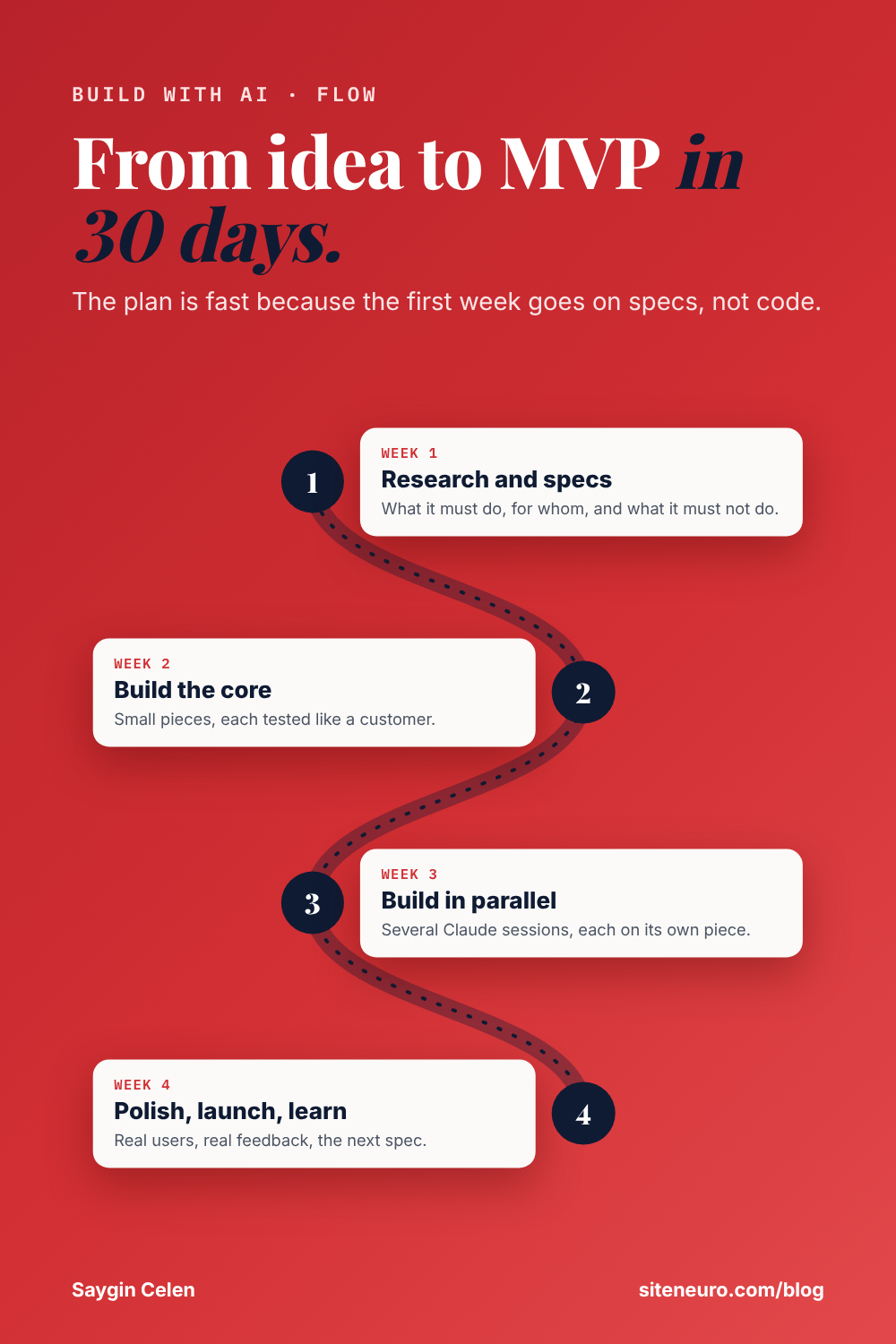
| Week | Focus | Done when |
|---|---|---|
| 1 | Research + specs + cross-check | A version 1 spec you'd hand to a builder |
| 2 | Build the core, one tested piece at a time | The core problem works end to end |
| 3 | Build in parallel sessions | All MVP features work |
| 4 | Polish, launch to real users, learn | 10 real users and a list of next rules |
Straight answers
Can I build an MVP with AI without coding?
How long does it take to build an MVP with AI?
What's the most important step when building with AI?
Should I use more than one AI model?
What do people underestimate about building with AI?
 What is SiteNeuro?The AI growth platform for small businesses and entrepreneurs, starting with a website.See the sites it builds and the marketing it runs, in the showcase →Rated Excellent on Trustpilot
Building an AI platform?
I built SiteNeuro as a non-developer, with Claude and written specs: 1,000+ websites built so far.
If you're turning an idea into an AI product, I can help you shape the business case, set up Claude and your specs, and plan a first build that doesn't loop.