Build With AI
How I Use ChatGPT, Gemini and Claude Together to Review a Plan (Before Anything Gets Built)
One AI agrees with its own plan. Three can find what it missed. How I make them argue, and who gets the final word.
How do you use multiple AI models together? Don't ask them all to do the work.
Ask one to plan, the others to attack the plan, and let your goal settle the arguments.
I call it the 4-AI Review Loop.
Here's how it works, two prompts to copy, and a real example.
This is episode 3 of Specs + Claude, a weekly series on building real products with Claude when you're not a developer (why specs beat vibe coding). Episode 1 covered the brief, episode 2 the plan. This one is how I stress-test the plan before I approve it.
The problem: one AI grades its own homework
Plan mode gives you a plan before any code. That's a big step.
But the plan came from Claude, and Claude will find its own plan reasonable. That's not a flaw in Claude. It's true of any single author, human or AI.
Every model has blind spots, and they're different blind spots. A second and third model trained differently will question things the first one took for granted.
Anthropic recommends the same idea inside Claude Code: have a fresh reviewer check the work, so "the agent doing the work isn't the one grading it." (Claude Code best practices)
I take it one step further, and use reviewers from other companies.
The method: the 4-AI Review Loop
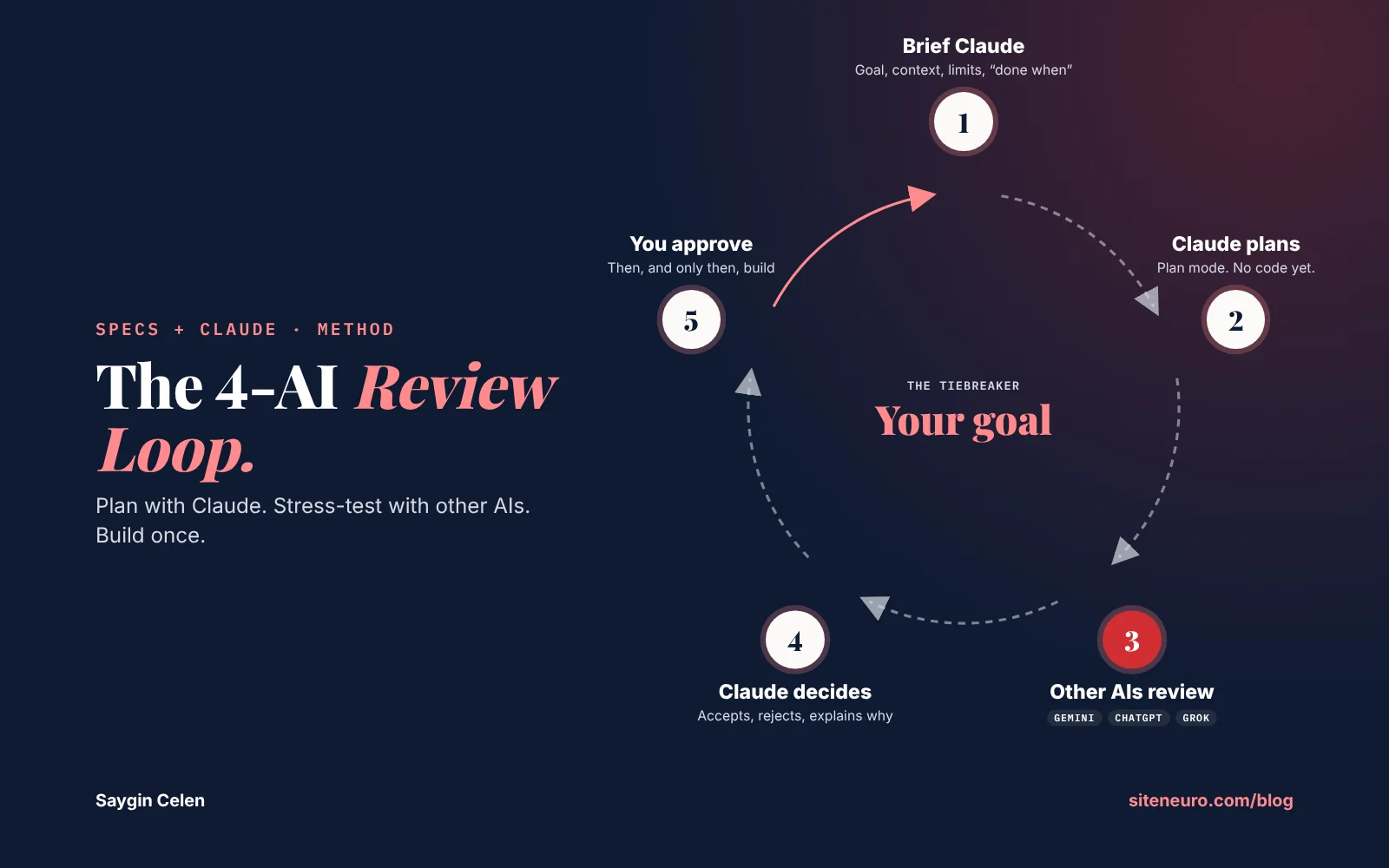
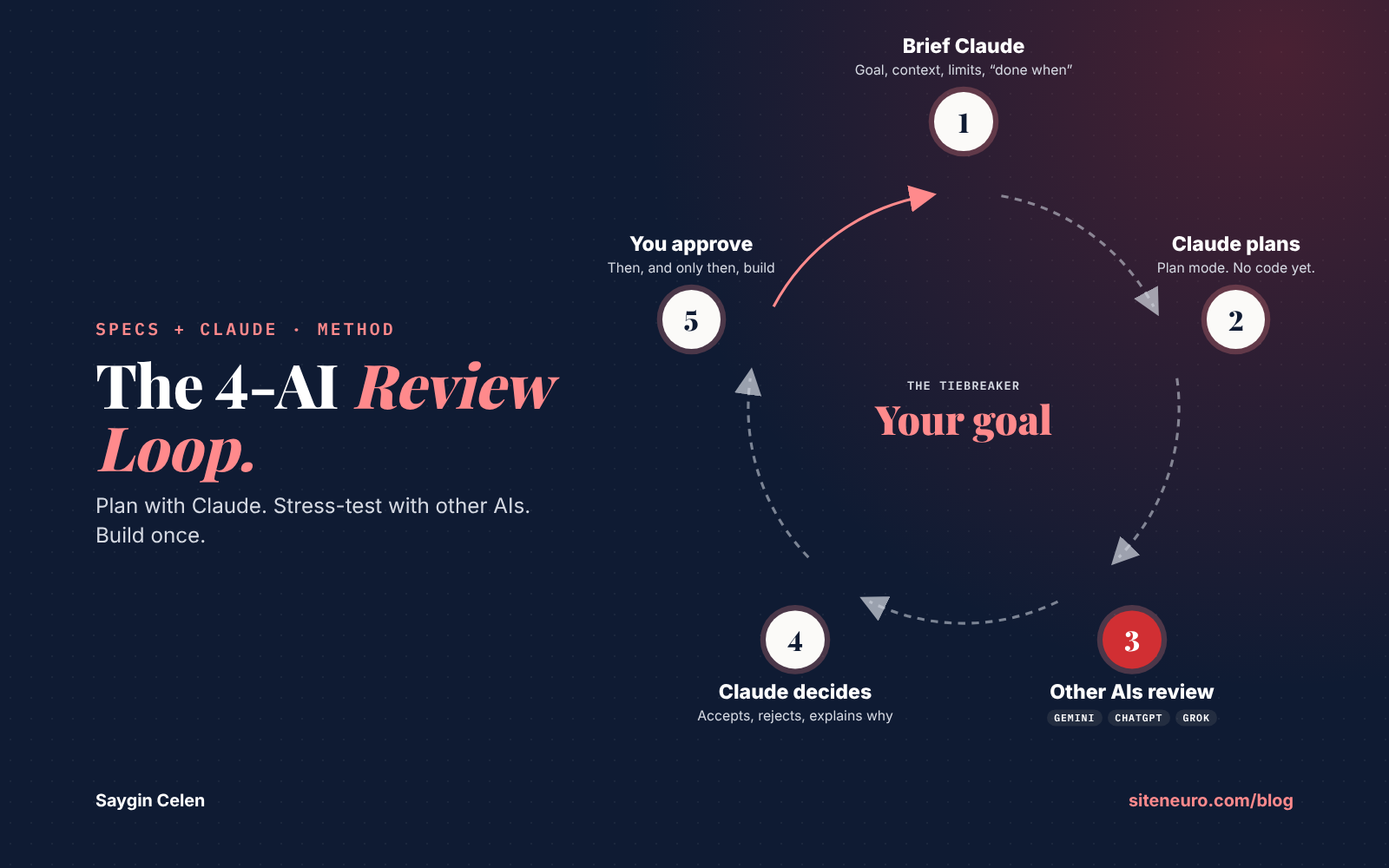
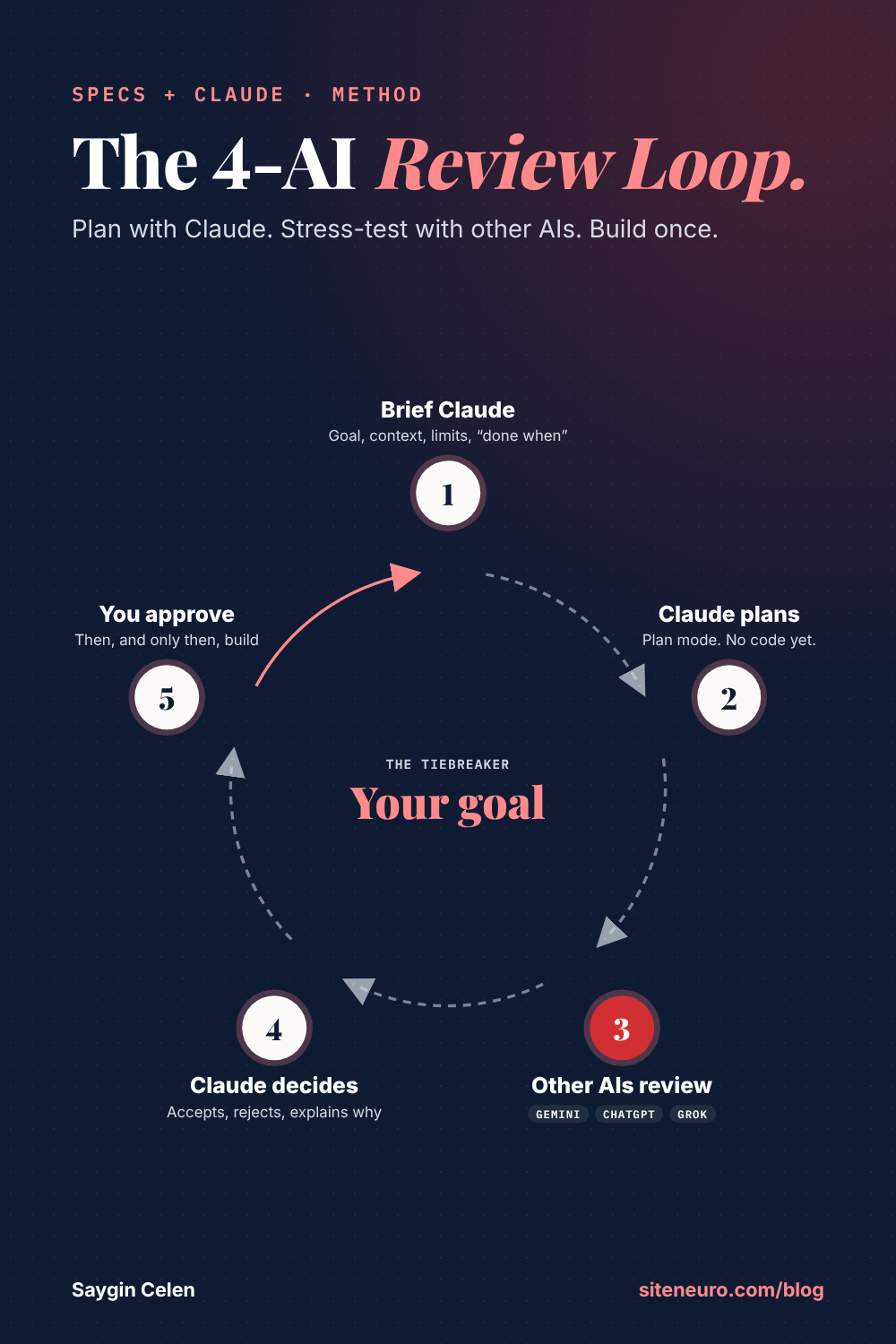
- Brief Claude. Goal, context, limits, done when. (Episode 1's template.)
- Claude plans. In plan mode. No code yet. (Episode 2.)
- Other AIs review the plan. I use ChatGPT, Gemini and Grok. Each gets the same plan and the same instructions: find the risks, not the compliments.
- Claude decides. I bring every review back to Claude, together with the goal. Claude accepts, rejects or checks each point, and says why.
- You approve. Only then does anything get built.
The centre of the loop is the most important part: your goal is the tiebreaker. Not the majority. Not the most confident reviewer.
Step 3: how to ask for a review
"Is this a good plan?" gets you a polite yes and some generic tips.
Ask for failure instead. This is the prompt I paste into ChatGPT, Gemini or Grok:
You're reviewing a plan before anything is built.
Don't rewrite it and don't praise it.

GOAL: [the goal, in one sentence]

WHAT YOU CAN'T SEE: [what already exists, the limits,
any data that matters]

THE PLAN: [paste the plan]

Tell me:
1. The riskiest assumption, and how to test it cheaply.
2. The three most likely ways this fails.
3. What's missing.
4. What you would cut.

Rate your confidence in each point. If you'd need information
you don't have to judge something, say exactly what.
The "what you can't see" line matters. A reviewer outside your project only knows what you paste. Telling it so makes it flag its own guesses instead of presenting them as facts.
Step 4: how Claude decides
This is where most people go wrong with multiple AIs: they read three answers and go with the one that sounds best.
The book
Plan with one AI. Stress-test with three.
Build Your AI Platform teaches non-technical founders to build real products with specs and Claude. Chapter 1 is free.
- 29 chapters, five levels, step by step
- Three complete builds, start to finish
- Templates, checklists and a prompt kit
- Chapter 1 is free to read, in full

Instead, give all the reviews back to the AI that has the full context, with the goal, and make it justify every decision:
Here are reviews of your plan.
ChatGPT: [paste]
Gemini: [paste]

Our goal is still: [goal]

For every point the reviewers make:
- accept it, reject it, or mark it "needs data", with one line on why;
- check any claim you can verify against our files and data;
- where reviewers disagree with each other or with you,
  use the goal to decide.

Don't count votes: one reviewer can be right against two.

Then give me the revised plan and a short list of what changed.
Don't build anything until I approve.
Claude can see things the reviewers can't: the files, the history, the data. That's why it decides, and why you still approve.
A real example: reviewing this blog's strategy
When I planned SiteNeuro's blog strategy, I ran this loop on it.
I asked ChatGPT and Gemini to review the strategy. Then I brought both reviews to Claude, together with our Search Console data and the goal: more traffic, a stronger brand and more conversions.
Here's what came out of it:
- Two "new" articles the reviewers recommended already existed. They couldn't see the blog. Writing them again would have made our own pages compete with each other. Claude rejected the idea and proposed improving the existing pages instead.
- The reviewers suggested a posting pace we'd already passed. Again, not their fault: they couldn't see the schedule.
- One suggested headline used a statistic nobody could source. Our writing rules forbid made-up numbers, so it was out, however catchy it sounded.
- One prediction was more optimistic than the data supported. The Search Console numbers said to wait and measure before changing the pages everyone was pointing at.
- But they were right on the big ideas, and Claude kept them: let search data choose topics, organise posts around hub pages, and write AI news as analysis, not summaries.
- And the data found something neither reviewer could: a small group of pages already ranking near the top of Google for exactly what our customers search. That became the first priority.
I approved the final plan. It's the one this series is part of.
The lesson: an AI reviewer knows only what you've told it.
That's why I keep one long-running conversation per project in each of them: ChatGPT, Gemini and Grok. Over time they learn how the project works and the principles behind it, so their reviews get sharper.
But even a well-briefed reviewer can't see today's files or data. That's why they review and Claude decides.
The rules that make it work
- Don't average the reviews. Three models agreeing doesn't make them right. The goal decides.
- Ask for failure modes, not compliments. "What breaks?" beats "Is this good?" every time.
- Give reviewers context, and say what they can't see. Keep one ongoing conversation per project in each AI so it learns how the project works. Then name what's missing, or it fills the gaps with confident guesses.
- Watch what you paste. Confidential data, customer details and keys don't go into every chat. Summarise instead.
- Know when it's overkill. A 10-minute fix doesn't need four AIs. I use the loop for anything that changes direction, costs money or touches many files.
The rules that make the review loop work
Don't average the reviews
Three models agreeing doesn't make them right. The goal decides.
Ask for failure modes
"What breaks?" beats "Is this good?" every time.
Give context, name the gaps
Say what reviewers can't see, or they fill gaps with confident guesses.
Watch what you paste
No confidential data, customer details or keys. Summarise instead.
Know when it's overkill
A 10-minute fix doesn't need four AIs.
New tool spotlight: "AI council" skills
The same idea now comes packaged. Developers have built "LLM council" tools, inspired by Andrej Karpathy's open-source LLM Council: several models answer or review the same question, critique each other, and one model combines the results. Some of them run as Claude Code skills that send your plan to other models and bring a merged verdict back.
Two cautions before you install one:
- They're community projects, not Anthropic products. Read what a skill does before you run it.
- They send your plan to other companies' APIs, usually with your own API keys, so each review costs money and shares your plan. Copying and pasting by hand is slower, but it's free on the plans you already pay for and you see exactly what leaves your computer.
If you'd rather stay inside Claude, Claude Code can also run a reviewer subagent in a fresh context to attack its own plan. It's the same model, so it shares some blind spots, but it costs nothing extra to try.
Straight answers
How do I use multiple AI models together?
Can ChatGPT and Claude work together?
Which AI is best for reviewing a plan?
What if the AI reviewers disagree?
Is it safe to paste my plan into several AI tools?
Is reviewing with several AIs worth the time for every task?
 What is SiteNeuro?The AI growth platform for small businesses and entrepreneurs, starting with a website.See the sites it builds and the marketing it runs, in the showcase →Rated Excellent on Trustpilot
Building an AI platform?
I built SiteNeuro as a non-developer, with Claude and written specs: 1,000+ websites built so far.
If you're turning an idea into an AI product, I can help you shape the business case, set up Claude and your specs, and plan a first build that doesn't loop.